
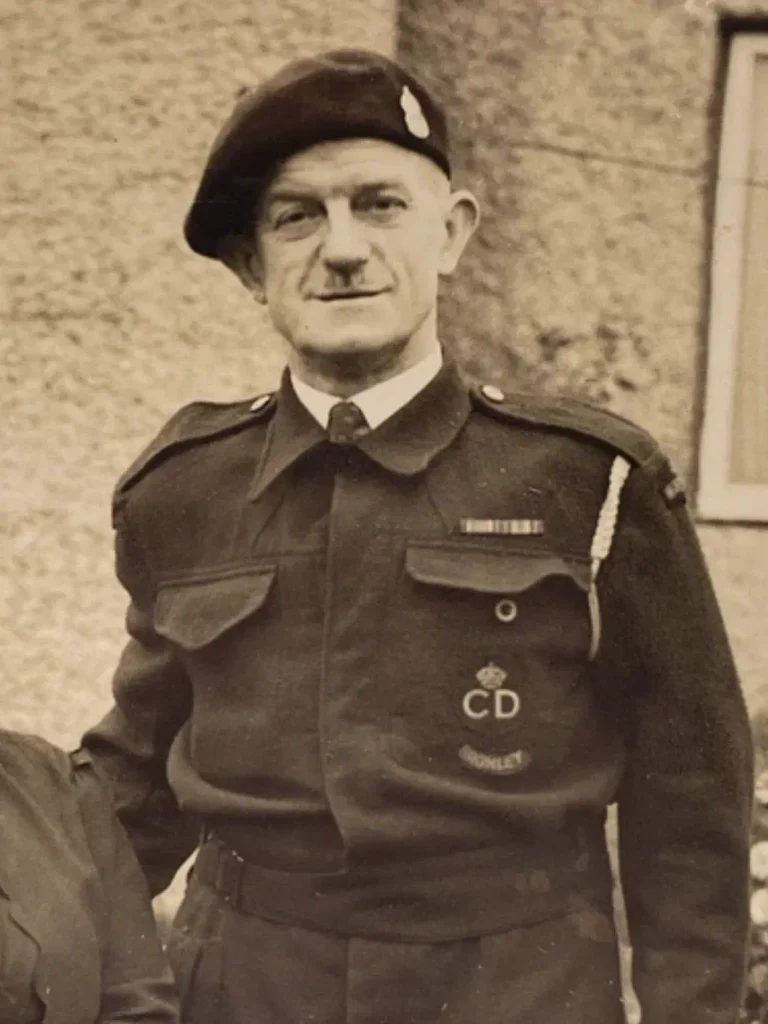
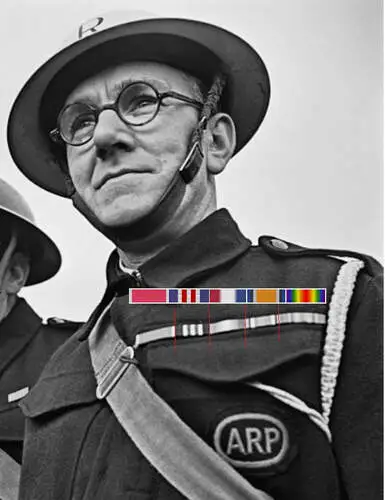
All Civil Defence personnel, regardless of rank, were permitted to wear medal ribbons above the left breast pocket (the right when seen from the observer).
First World War Medal Ribbons#
A large number of photographs featuring air raid wardens and other CD members from the second world war show them wearing first world war ribbons on both the bluette overalls and battledress jackets.
British Empire Medal (BEM)#
The civil division of the British Empire Medal was awarded to members of the Civil Defence Services for commendable service or bravery.
King’s Commendation for Brave Conduct#
The King’s Commendation for Brave Conduct was first instituted in 1916 to recognise bravery by civilians. Up until 1943, the award came as just a certificate. In 1943 a plastic gold and red badge featuring a sword surrounded by a wreath and surmounted by a crown with “For Brave Conduct” written in the centre was created. Badges were issued in a small red cardboard box to those receiving the commendation (boxes containing single or two badges are known to exist). The badges were 38mm long by 20mm wide and designed by George Kruger Gray.

Silver Laurel Leaf#
From 1944 the small plastic badge was replaced by a silver metal laurel leaf emblem for civilian recipients. This could be attached to the Defence Medal ribbon (issued post-war) if awarded or directly to the lapel. The first pattern laurel leaves were fixed with two pins and the second pattern with a brooch fitting. The emblem was to be worn with the stalk furthest from the left shoulder.

Both the badges and laurel leaves were intended to be worn on civilian clothes (though there is photographic evidence of the badge being worn on the left pocket of the battledress blouse) and recipients were generally issued with two badges or laurel leaves. Recipients that had received just the certificate were issued with the plastic badges and then later the laurel leaves. Recipients that had been awarded the plastic badges were later also issued the laurel leaves. See this blog post for awards received by Albert Dore, a Rescue Squad volunteer.
The award of a King’s Commendation for Bravery could be made posthumously. It is thought around 2,000 awards were made to members of the Civil Defence Services (including police officers) during the Second World War.


WW2 The Defence Medal for Civil Defence Services#
Although issued after the Civil Defence Services had stood down, the Defence Medal (instituted in May 1945) was awarded to all members of the various civil defence services who had received three or more war service chevrons (one chevron equalled one year’s complete service). Quite a number of Civil Defence volunteers enrolled with the Civil Defence Corps from 1949 and would wear the Defence Medal ribbon on their uniform.
The colours on the ribbon had the following meanings:
- Orange – denotes the fires caused by enemy bombing
- Green – symbolises Britain’s green and pleasant land
- Black – represents the blackout
See the Defence Medal entry on Wikipedia for more information on award criteria.
